
Food storage and distribution sites
Food-Grade Warehouse Cleaning
Food-grade warehouse cleaning is the cleaning a food storage or distribution site needs to satisfy its food safety plan and its auditors: approved chemicals, a fixed zone order, pest-conscious detail and a written record of every task. We provide it for dry stores, chilled warehouses, beverage DCs and food packaging stores in Melbourne, and we are clear that production-line sanitation is a different trade. It sits alongside the other warehouse and industrial services we offer, and is always scoped site by site.
Every food-grade site starts with a walk-through alongside your QA manager, because your plan sets the rules, not ours.
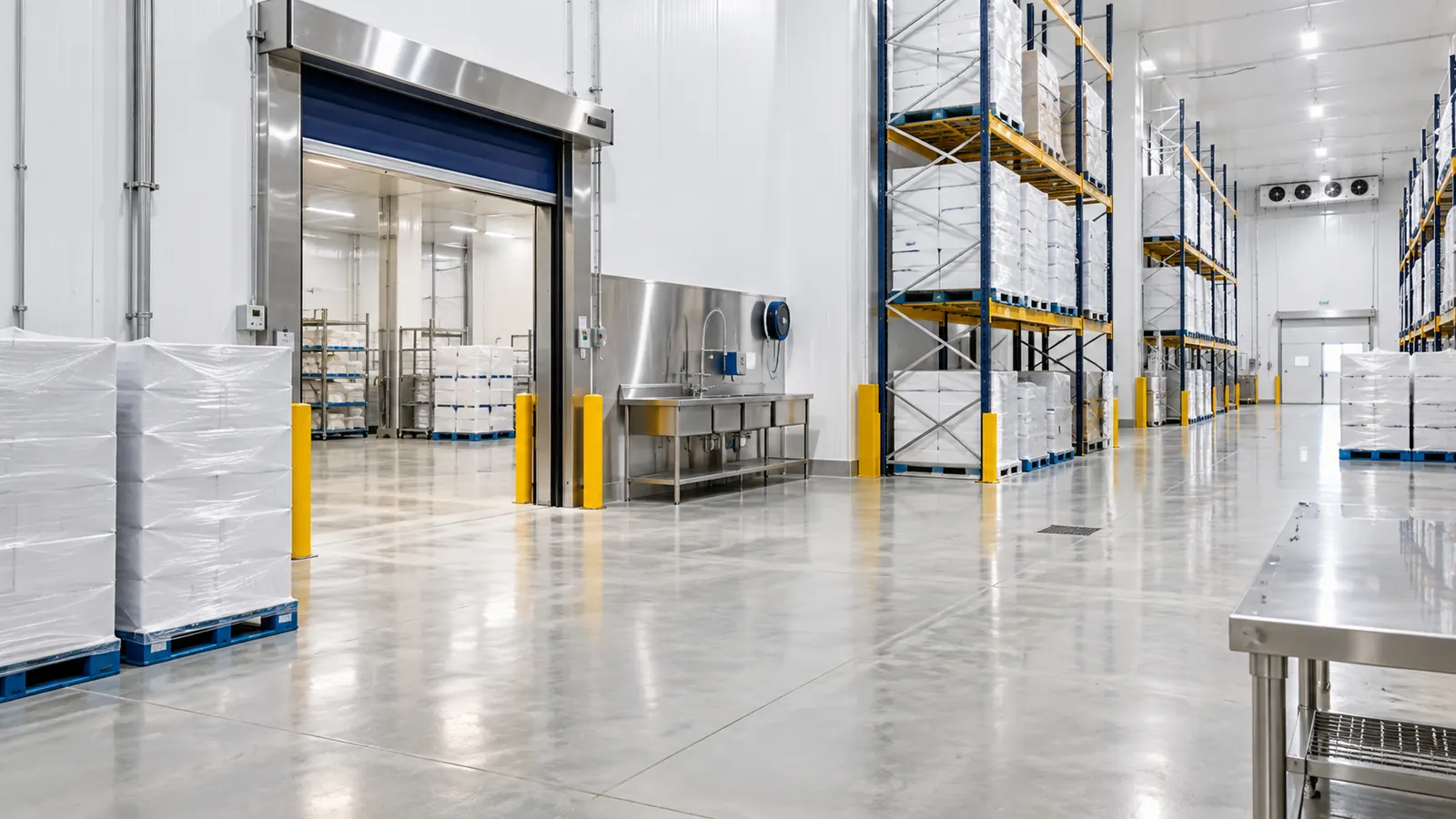
Food sites we clean
- DRYAmbient stores
- COLDChilled rooms
- BEVBeverage DCs
- PACKPackaging
- Your approved chemicals or ones your QA signs off
- Fixed zone order, clean areas first
- Record for every task, signed and dated
- Storage sites only, not line sanitation
What does food-grade warehouse cleaning actually mean?
Food-grade warehouse cleaning is building cleaning that a food safety plan can rely on: only approved products, a set order from clean to dirty areas, nothing left that could reach food, and a record that proves each task was done.
Food Standards Australia New Zealand explains that premises, fixtures and equipment must be kept clean and sanitary under its cleaning and sanitising guidance, and that cleaning removes dirt and food waste while sanitising destroys microorganisms. In a storage warehouse, most of our work is the cleaning half, done so the site's own sanitising steps can work.
| Question | Standard warehouse clean | Food-grade clean |
|---|---|---|
| Chemicals | General industrial cleaners | Only products on your approved list, with data sheets on file |
| Order of work | Whatever is efficient | Clean zones first, waste and docks last |
| Equipment | Shared across the site | Colour-coded and kept to one zone |
| Detail | Visible floor and surfaces | Wall junctions, under racking, drains, dock seals |
| Evidence | Visit report | Task-by-task cleaning record the QA manager files |
How are chemicals, methods and zoning handled on a food site?
Chemicals come from your approved list, or are submitted to your QA manager with data sheets before first use. Work runs in a fixed direction from the cleanest zones to the dirtiest, with equipment that never crosses between them.
A typical food storage site has five kinds of area. The strip below is the order we clean them in, so dirt and residue move one way only. Chilled rooms are cleaned with low-temperature products and dried properly, because water left on a cold floor turns to ice.
Offices and QA room
General cleaning, blue kit, no food contact.
Packaging store
Dust control only, dry methods where possible.
Ambient food store
Floors, racking bases, wall junctions.
Chilled and frozen
Low-temperature products, floors left dry.
Docks and waste
Heaviest soil, own equipment, never carried back.
New products are never introduced mid-contract without sign-off. If a supplier changes a formula or a product is discontinued, the replacement goes to your QA manager with its data sheet first, and the chemical list in our site file is updated before the first bottle arrives.
Amenities and staff rooms follow the site's own colour code, with toilet equipment kept completely separate from anything used near food. If your plan says a zone must be cleaned before first receiving, or after the last pick, the schedule is built around that.
What documentation will your QA manager get?
A cleaning record for each visit showing the area, the task, the product used, who did it and when, signed by our supervisor and ready for your team to verify. It is built to be filed with your food safety records.
Food auditors ask the same questions every time: what was cleaned, when, with what, and who checked it. A record that answers all four, in the same layout every visit, saves your QA manager rebuilding it before the audit.
We also keep a site file with the approved chemical list, data sheets, crew inductions and the agreed cleaning schedule. When a product or a person changes, the file is updated first and you are told.
Before a scheduled audit, we can run an extra detail visit on the areas auditors look at hardest, and bring the records for the period together in date order so your team is not searching for them on the morning.
If a task could not be done, because an area was full or not released, the record says so rather than leaving a gap for an auditor to find.
What does pest-conscious detailing involve?
Cleaning the places pests feed and hide: under racking, along wall and floor junctions, around dock seals and drains, and anywhere spilled product can gather. It supports your pest controller rather than replacing them.
Pest control contractors find most activity where cleaning is weakest, and Melbourne's older food stores in the inner west and north, with timber-lined walls and many small gaps, need that detail more than new tilt-slab sheds. Even a spilled bag of flour behind a pallet, crumbs along a wall line or a drain that is never lifted is enough. Our detailing targets those spots on a cycle, and anything we see, such as droppings or gnawed packaging, goes straight on the report.
Under racking
The strip under the bottom beam, vacuumed and wiped, with spilled product removed rather than pushed further back.
Wall junctions
The line where floor meets wall, kept clear so your pest inspector can see it and nothing can build up along it.
Dock seals and doors
Seals, door tracks and the gap under roller doors, where debris blows in and pests enter.
Drains and grates
Lifted, cleaned and replaced on a set cycle, so food residue does not sit in them.
Spill points
Pick faces and returns areas, where damaged stock leaks, cleaned every visit.
Waste bays
Bins, compactor surrounds and the ground beneath, washed with runoff captured.
What changes in chilled and frozen rooms?
Almost everything: the products, the amount of water, the timing and the drying. Cold rooms are cleaned with low-temperature cleaners, as little water as possible, and a thorough dry, so no film or ice is left on the floor.
Water on a chiller floor freezes fast, and a thin sheet of ice between racks is a serious slip hazard for pickers and forklifts. We use small, controlled amounts of solution, recover it straight away and dry the floor behind the machine.
Cold room checklist
- Low-temperature cleaners chosen for chilled floors
- Minimal water, recovered straight away
- Floors dried behind the machine
- Dry methods for routine freezer work
- Door seals and strip curtains wiped
- Timing agreed with refrigeration and receiving
Freezer rooms are harder again. Wet cleaning is usually avoided altogether, and dry methods such as vacuuming and scraping are used for routine work. Deeper cleans are planned with your team for when the room can be run warmer or emptied, and the time needed to bring it back to temperature is built into the plan.
Crews working in cold rooms wear the right gear and take breaks outside the room, following your site's rules for time spent in the cold.
How are allergens and customer codes respected?
By following your allergen controls and any customer codes of practice to the letter: dedicated equipment where the plan asks for it, a set cleaning order around allergen storage, and records that show it was done.
Many food warehouses store allergen-containing products, such as nuts, sesame or gluten, next to products that must stay free of them. Spilled product in those areas is removed with dedicated equipment and not spread with a shared mop or pad. Retailer and brand-owner codes often add their own rules on top, and we work to whichever is strictest. We do not write or approve your allergen plan; we follow it, and we flag anything on the floor that looks like it could put the plan at risk.
Where does our food-grade work stop?
At the production line. We clean food storage and distribution buildings, not the inside of processing equipment. Line sanitation, clean-in-place systems and food-contact surfaces in production belong to a specialist hygiene contractor or your own sanitation crew.
Saying this plainly matters. A food business that assumes its warehouse cleaner is also covering production hygiene has a gap in its food safety plan. On mixed sites, we work alongside the sanitation team and agree in writing where each of us starts and finishes.
| Area or task | Who handles it | Why |
|---|---|---|
| Storage floors, racking, walls, docks | Us | Building cleaning to your plan |
| Amenities, lunchrooms and offices | Us | Same visits, separate colour code |
| High-level dust over food storage | Us, with stock covered | Planned around your production calendar |
| Production lines and food-contact surfaces | Your sanitation crew or hygiene contractor | Needs validated sanitation procedures |
| Clean-in-place systems and tanks | Specialist contractor | Plant internals and often confined spaces |
How often should a food warehouse be cleaned?
Most food storage sites need floors and spill points cleaned several times a week, amenities daily, pest-conscious detailing monthly, and high-level dust every six to twelve months. Your food safety plan and audit history set the exact cycle.
Food sites almost always run on a program rather than one-off cleans, because auditors look for a consistent pattern, not a good day. Our scheduled cleaning programs for industrial sites put the cycle in writing and keep the records in one place.
Food distribution in Melbourne clusters around the Epping market precinct in the north and the big western estates, and many of those sites run chilled and ambient stock side by side. That usually means two cycles in one program, with the chilled rooms cleaned at a time that suits the refrigeration.
The dust and housekeeping side of a food site is covered in more detail in our guide to warehouse dust and housekeeping.
How do you get a food-grade site quoted?
Send the floor area, the mix of ambient and chilled storage, any approved product list and your audit schedule. After a walk-through with your QA manager, a fixed program price follows, with the record format already agreed.
The walk-through is where the zone order, colour code and product list are settled, so it pays to have QA in the room. How the monthly figure is built is explained on our warehouse cleaning prices page.
Quote a food-grade siteFor non-food storage, see our general warehouse cleaning in Melbourne.
- Floor area, storage mix, chemical list and audit dates
- Walk-through with your QA manager
- Fixed program price, zone order and record format agreed
- Inductions, colour code briefing and first visit
What do QA managers ask about food-grade warehouse cleaning?
These three answers usually settle whether our service suits your site.
Site-specific requirements, such as allergen controls or customer codes, can be sent with the request.