
Concrete floors, aisles, docks
Warehouse Floor Cleaning and Scrubbing
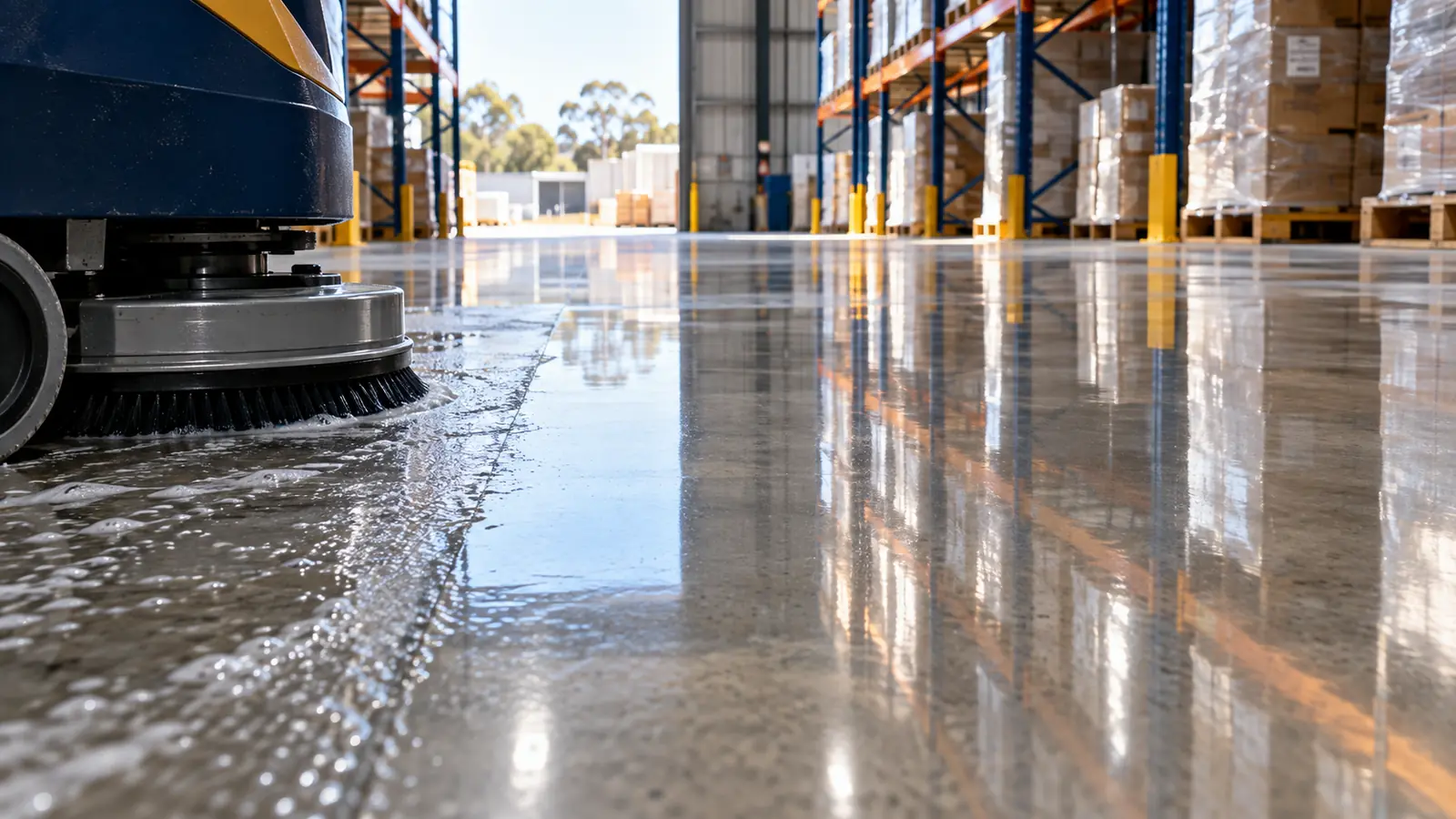
Our warehouse floor cleaning in Melbourne takes concrete floors from dusty and marked back to clean, dry and safe to walk, using ride-on sweepers and scrubber-driers sized to your aisles. It suits distribution centres, storage sheds and factories where forklift traffic, pallet dust and spills wear a floor down faster than a mop can keep up. Floors are one part of the full set of warehouse and industrial services we run, and often the first one a site books.
Most visits happen overnight or between shifts, and the floor is handed back dry before your first forklift moves.
Floors we clean most
- DCRacked aisles
- DOCKLoading docks
- PLANTFactory floors
- UNITSmall sheds
- Dry before first shift on every night visit
- Our own machines and chemicals, nothing to hire
- Wet zones barricaded and signed while we work
- Dirty water to sewer, never to a yard drain
What does warehouse floor cleaning involve?
Warehouse floor cleaning in Melbourne means removing loose dust, lifting the film that settles into concrete, treating tyre marks and spills, and cleaning the edges along racking and walls. It is done by machine, on a cycle that matches your traffic.
Most floors we are called to have not failed all at once. They fail an audit, or a customer visit, one small problem at a time. The four below are the ones site managers mention most. Each has its own fix, and a good floor program deals with all four.
Dust build-up
Pallet fibres, shrink-wrap scraps and grit drift into aisles and corners, then blow back onto stock.
Tyre marks
Black streaks at turning points and dock plates make a floor look neglected even when it is swept.
Spill residue
Old drink, oil and product spills leave sticky patches that catch dirt and reduce grip.
Faded lines
Walkway and bay markings disappear under grime, and your traffic plan stops being visible.
Melbourne adds its own twist. Winter rain tracks water and grit in through every open roller door, and the dock end of most sheds gets dirty far faster than the back of the building. We clean those zones more often rather than scrubbing the whole floor at the same rate.
What is the right order: sweep, scrub or edge first?
Sweep first, scrub second, then edge. Sweeping removes the dry dirt that would otherwise turn to paste under a scrubber. Scrubbing lifts the film. Edge work cleans the strip no machine can reach.
Skipping a step is the most common reason a floor still looks grey after it has been "cleaned". Each pass does a job the others cannot, and the whole sequence usually runs in a single night.
Picks up grit, wrap, pallet splinters and dust in one pass, with a filter so the dust is caught rather than thrown back into the air. Corners and under-rack strips get a hand broom or vacuum.
Lays down a measured amount of solution, scrubs the surface and vacuums the dirty water back up. We choose a neutral or alkaline cleaner to suit sealed or bare concrete.
Cleans the band along racking bases, walls, columns and door tracks. This is where dust and pests gather, and where most audit photos are taken.
Does it matter if the floor is sealed, epoxy-coated or bare concrete?
Yes. The finish decides the chemical, the pad and how hard we can scrub. Bare concrete tolerates aggressive cleaning but stains easily; sealed and epoxy floors clean up faster but can be dulled or damaged by the wrong product.
Many sheds have a mix: a sealed main floor, bare concrete in older bays and an epoxy coating in the lunchroom or charging area. We note which is which on the walk-through and change pads and products as the crew moves between them.
| Finish | How it behaves | What we use | What to avoid |
|---|---|---|---|
| Bare concrete | Porous, soaks up oil, sheds dust as it wears | Alkaline cleaner, firmer pads, degreaser on stains | Leaving water to pool, which carries dirt deeper |
| Sealed or densified | Tight surface, dirt sits on top, cleans quickly | Neutral cleaner, medium pads | Strong alkalis that wear the sealer over time |
| Epoxy or polyurethane coat | Smooth and bright, shows every mark, can get slippery | Neutral cleaner, soft pads, thorough drying | Abrasive pads and solvent cleaners |
How are forklift tyre marks and spill residue removed?
With a targeted cleaner left to work for a few minutes, machine agitation, and a recovery scrub straight after. Most tyre marks come off in one treatment; older ones and oil stains in bare concrete may need a second pass.
Tyre marks are rubber, not dirt, so a general cleaner barely touches them. Oil soaks into unsealed concrete and keeps wicking back up. The table shows what we use for each, and when a mark is unlikely to come out completely.
| Mark | Where it forms | Treatment | What to expect |
|---|---|---|---|
| Black tyre marks | Turning points, racking ends, dock plates | Rubber-mark remover, pad agitation, recovery scrub | Usually gone in one pass |
| Hydraulic and engine oil | Forklift parking and charging areas | Degreaser dwell, scrub, repeat on old stains | Fresh oil lifts; old stains fade but may shadow |
| Sticky spills | Pick faces, lunchroom paths, returns areas | Scrape, targeted cleaner, scrub | Fully removed |
| Pallet wrap and tape glue | Wrapping stations and dispatch lanes | Solvent-safe remover, scraper, scrub | Fully removed |
| Rust and water marks | Under leaking roof sheets and doors | Mild acid-free treatment, scrub | Lightens; the leak needs fixing first |
Dock plates and the first few metres inside each roller door take the worst of it, because that is where forklifts brake and turn with a load. Those strips are treated on every visit, while the quieter back half of the shed might only need marks treated once a month.
Battery charging bays are a special case. Any acid spill is dealt with under your own spill procedure and kit before we scrub, and we do not handle battery electrolyte ourselves.
How do you control dust in racking aisles?
By removing it before traffic stirs it up: a filtered sweep of every aisle, vacuuming under the bottom beam, and a scrub that locks down the fine dust a sweeper leaves. Done often enough, the aisle air stays clear.
Racked aisles trap dust in two places. The strip under the lowest beam collects it from the floor, and the beam tops collect it from above. When a reach truck passes, both get stirred back into the aisle and settle on stock and labels.
Floor cleaning deals with the first. Narrow-aisle sites get walk-behind or compact machines that fit between racks, and the under-beam strip is vacuumed by hand, without moving pallets.
The second, the dust on beams, lights and roof steel, needs lifts and a closed aisle. It belongs in a separate high-level dust removal visit, usually once or twice a year, and ideally just before a floor scrub so the floor catches what comes down.
How should floors be prepared before line marking?
A deep scrub and degrease of the lines to be painted, then a full dry, so the paint bonds to clean concrete rather than to a layer of grime. Afterwards, the right cleaner and pad keep new lines bright for longer.
Line markers tell us the same thing: paint over dirt and it peels within months. We work to the marker's timetable, cleaning the night before they arrive, and hand over a floor that is dust-free and bone dry.
Before remarking
Old lines are faded and patchy, with oil and tyre marks across the walkway. Painting now would trap the dirt under the new coat.
Prepared
Degreased, scrubbed and dried along every line. The marker can grind or prime straight onto sound concrete.
Kept bright
A neutral cleaner and soft pads on the regular scrub, so the new paint is not worn away by harsh chemicals.
How do clean floors help your safety audit?
Slips and trips show up in almost every warehouse audit, and floor condition is the first thing an auditor looks at. A clean, dry floor with visible walkways removes the easiest findings and shows housekeeping is under control.
WorkSafe Victoria's slips, trips and falls guidance tells workplaces to clean up spills straight away and fix whatever is causing them. A floor program helps with both halves: regular scrubbing stops residue building up, and our visit reports note where the same spill keeps appearing.
- Walkways visible because the lines are clean
- No slippery film in pick and dock zones
- Wet floors signed and dried before reopening
- Repeat spills reported so the source gets fixed
- Edges clear of dust, wrap and debris
- Visit records you can show an auditor
The wider picture, including dust above floor level and what a housekeeping plan should cover, is in our warehouse dust and housekeeping guide.
How much does floor cleaning cost, and how often should it happen?
Price follows floor area, condition and how often you book. A first scrub of a neglected floor costs more than the maintenance visits after it. Frequency follows traffic, from weekly on quiet sheds to nightly on busy DCs.
Use the guide below as a starting point. The walk-through usually shows that one zone, often the dock end, needs more than the rest, and the plan is set zone by zone.
| Traffic level | Typical site | Sweep | Machine scrub | Edges and marks |
|---|---|---|---|---|
| Light | Storage shed, few daily movements | Weekly | Monthly | Quarterly |
| Medium | Single-shift warehouse or trade supplier | Two or three times a week | Fortnightly | Monthly |
| Heavy | Two-shift DC or busy factory | Nightly | Two to five nights a week | Monthly |
| Continuous | 24-hour DC or cross-dock | Every shift, by zone | Nightly, by zone | Fortnightly |
A regular cycle is cheaper per square metre than calling us in when the floor gets bad, and it can be written into a scheduled cleaning program with a fixed monthly price. For how rates are built, see what goes into a warehouse cleaning price.
How do you get your floor area quoted?
Send the floor area in square metres, the layout, the floor's current state and the hours we can work. We confirm it on a short walk-through and send a fixed price for a one-off clean or a monthly cycle.
The estimator gives a rough idea of time on site with a two-person crew, so you can see whether the job fits your overnight window. It is a planning figure only. Aisle widths, obstacles and how bad the floor really is are measured on the visit.
Ride-on sweeper and ride-on scrubber-drier, two operators.
Planning estimate only, including edges and set-up. The fixed price comes from the walk-through. Quote my floor areaWhat do people ask about warehouse floor cleaning?
Three short answers to the questions we get before most floor jobs.
For how floors fit into the rest of a site's cleaning, our warehouse cleaning overview for Melbourne sites covers the full picture.