
Rafters, services, lights, racking tops
Warehouse Deep Cleaning and High-Level Dust Removal
Warehouse deep cleaning in Melbourne reaches the parts of a building routine cleaning never touches: rafters, beams, ducts, cable trays, light fittings, high walls and the tops of racking. Our industrial deep cleaning services use lifts, HEPA vacuums and a closed-aisle method, so dust is captured and carried out rather than knocked down onto pallets. It is one of the warehouse and industrial services we provide, usually booked once or twice a year.
The work is planned around your operations, and most sites stay open while we move through them one section at a time.
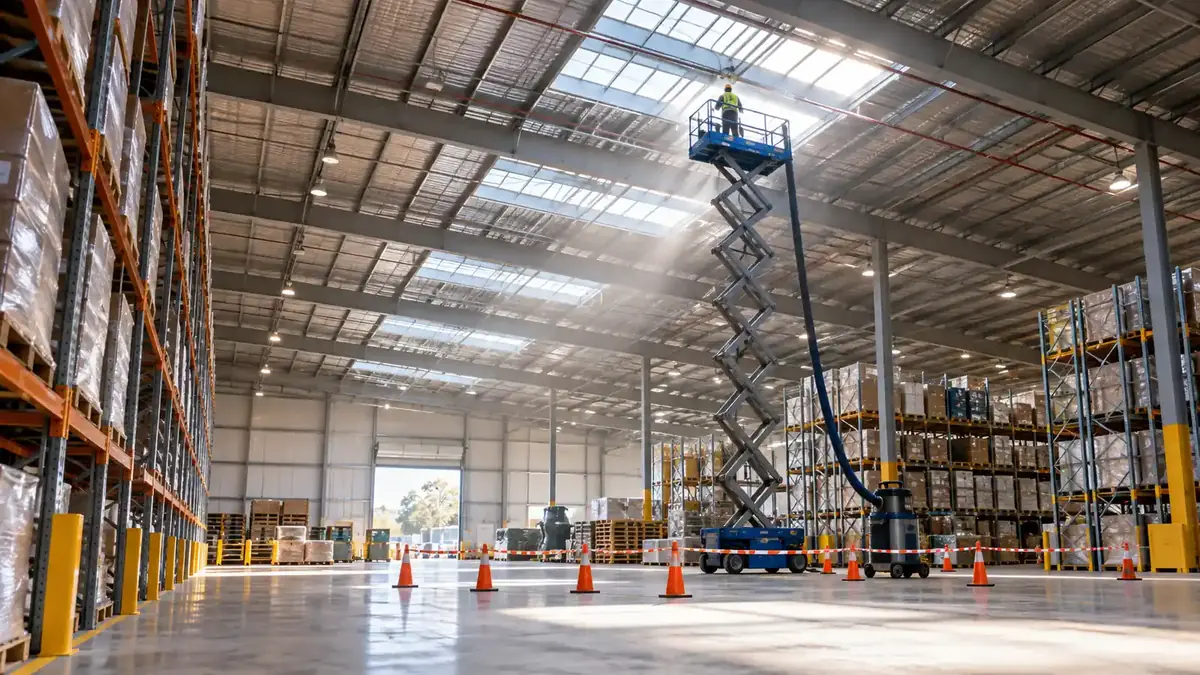
What we reach from the lift
- ROOFRafters
- SVCDucts, trays
- LUXLight fittings
- RACKTop beams
- HEPA vacuums at height, no blowing down
- Aisle closed below every lift
- Stock sheeted before work overhead
- Licensed operators for boom lift work
What does warehouse deep cleaning cover?
Warehouse deep cleaning covers every surface above normal reach: roof structure, services, lights, high walls, ledges and racking tops, finished with a floor clean underneath. It is the clean that resets the building, rather than maintaining it.
Most Melbourne warehouses built from the 1990s onwards have 10 to 14 metres of clear height, and big distribution centres in the west go higher. Almost none of that space gets cleaned in a normal week, so it quietly collects years of fine dust. The table shows what we reach and how.
| Surface | Usual height | Access | Method |
|---|---|---|---|
| Walls, doors and ledges | Up to 4 m | Floor with extension poles | HEPA vacuum, damp wipe where suitable |
| Racking top beams | 6 to 12 m | Scissor lift in the aisle | Vacuum along the beam face and top |
| Light fittings | 8 to 12 m | Scissor or boom lift | Vacuum, then wipe diffusers when cool |
| Ducts and cable trays | 8 to 13 m | Scissor or boom lift | Vacuum exterior, no disturbance of cables |
| Rafters, purlins and roof sheet underside | 10 m and up | Boom lift over racking where needed | Vacuum section by section, top down |
Why does high-level dust matter?
Because it does not stay up there. It falls onto stock and packaging, dims lights, coats detectors and sprinkler heads, and turns up in audits. On some sites, settled dust is also a housekeeping and fire-load issue in its own right.
Melbourne's weather plays a part too. Dry, windy days in summer blow fine grit through open roller doors, and it rises with the warm air before settling on the highest steel. Nobody looks up during a normal day, which is why high-level dust tends to be noticed only when something goes wrong: a customer rejects a dusty pallet, an auditor photographs a beam, or the lights seem dimmer than they used to be.
Stock
Dust drops onto cartons, shrink-wrap and open product every time a forklift or roller door disturbs the air.
Light
Coated fittings put out noticeably less light, which shows first in pick faces and label reading.
Fire services
Dust on detectors and sprinkler heads is something fire service contractors notice and report.
Audits
Customer, food safety and insurance audits increasingly look above the floor, not just at it.
A careful word on fire. Some dusts, such as fine flour, sugar, timber, plastics and certain chemicals, can burn or even ignite when disturbed in a cloud. Most general warehouse dust is not in that category. If your site handles material that is, your safety advisor will already have a housekeeping plan, and we clean to it: vacuums only, no compressed air, and no sparks near settled dust.
How are rafters, beams, services and lights cleaned?
One section at a time, from the roof line down, with HEPA vacuums on the lift and the aisle below closed. Each section is finished and checked before the lift moves on, so a site can keep working around us.
The sequence below is the same on every job. What changes is the lift type, the number of sections and whether we need to work over racking with a boom rather than between it with a scissor lift.
Close
Barriers, signs and a spotter mark the section. Forklift traffic is diverted with your shift lead.
Cover
Exposed stock, open product and sensitive equipment below are sheeted and taped.
Vacuum
Roof steel, services and lights are vacuumed top down. Air lances are only used where a vacuum cannot reach.
Lower levels
Racking beams, walls and ledges on the way down, so nothing is re-soiled from above.
Release
Sheets folded inwards, floor swept, section checked with you and reopened.
A boom-type lift with a boom 11 m long or longer needs an operator holding a WP class licence, which WorkSafe Victoria sets out in its guidance on elevating work platforms. Operators on our jobs hold the right class, and the lift's inspection records travel with it.
How is racking cleaned without unloading it?
Top beams and frames are vacuumed with stock in place, empty bays get a full clean, and floor-level beams are done from the aisle. Stock is only moved if you want the inside of every bay cleaned, and that is planned with your team.
Racking collects dust in layers. The top beams catch what falls from the roof, the middle levels catch what drifts off pallets, and the bottom beam catches everything kicked up from the floor. Each level has its own approach.
Top beams and frames
Cleaned from a lift with pallets left in place. The beam face, top and upright tops are vacuumed, which is where most visible dust sits.
Empty and part-full bays
Empty bays get a full clean. Part-full bays are cleaned around the load. Your team can empty chosen bays ahead of us if you want them done fully.
Bottom beams and floor strip
Vacuumed from the aisle, then the floor under the beam is cleaned, where dust, wrap and pests tend to gather.
Cold rooms and freezer bays are a special case. Ice and condensation turn dust into a paste on the beams, so we plan those areas for when the room can be warmed or run at a higher temperature, and use dry methods only.
We do not climb racking, stand on beams or move stock with your forklifts. Damaged racking we notice on the way past, such as a bent upright or missing beam lock, goes on the report so your racking inspector can look at it.
How is stock protected during overhead work?
By covering it before the lift goes up, working only over closed and sheeted areas, and vacuuming instead of blowing. Anything too sensitive to cover is moved by your team first, and the plan is agreed on the walk-through.
Food, pharmaceuticals, electronics and open product need the most care. We agree with you which bays count as sensitive, cover them with clean sheeting that has not been used on another site, and keep overhead work away from them until they are protected.
- Sensitive bays marked on the site plan before we start
- Fresh sheeting for food and sensitive stock
- Sheets folded inwards so collected dust does not spill
- No compressed air above uncovered stock
- Section sign-off with your supervisor before reopening
How often should a warehouse be deep cleaned?
Once a year for most distribution centres and busy warehouses, every six months for dusty processing or food sites, and every two years for quiet general storage. Routine floor and amenity cleaning carries on between deep cleans.
The best interval is the one that stops dust reaching the point where it falls on stock. We look at the steel on the first walk-through and give you an honest figure, then check it again at the next clean.
| Site type | Usual interval | Why |
|---|---|---|
| Quiet general storage | Every 2 years | Little traffic, doors mostly shut |
| Distribution centre or 3PL | Every 12 months | Constant traffic and open docks |
| Food storage | Every 6 to 12 months | Audit and product exposure |
| Dusty processing or manufacturing | Every 6 months | Dust is produced inside the building |
Mezzanines deserve their own mention. The underside of a mezzanine floor, and the storage on top of it, sit in the dustiest air in the building and are often skipped because they are awkward to reach. We include both in the scope unless you tell us otherwise.
Before we arrive, it helps if the site clears aisle ends, parks forklifts away from the first sections and moves anything stored on top of racking that should not be there. A short list goes out with the booking confirmation.
A deep clean can be written into a yearly cleaning program alongside routine visits, with the date fixed a year ahead. Book the floor scrub and sweep for the night after, so everything that comes down is removed. For the housekeeping side of dust, see our dust and housekeeping compliance guide.
How long does a deep clean take, and what drives the cost?
Most mid-sized warehouses take two to five nights or one long weekend. Cost follows the number of lift-days, not the floor area alone, so roof height, aisle width and racking height matter more than square metres.
A 5,000 m² shed with wide aisles and a 10 metre roof is a very different job from one of the same size packed with 12 metre racking and narrow aisles. The first can be done with scissor lifts in a few nights. The second may need a boom lift working over the racks, which is slower and costs more to hire.
| Factor | Effect | What helps |
|---|---|---|
| Roof and racking height | Sets the lift type and how far it travels | Clear aisle ends so lifts can turn |
| Aisle width | Narrow aisles rule out larger scissor lifts | Send the racking layout with the request |
| Stock sensitivity | More covering and slower work over food or open goods | Empty the most sensitive bays first |
| Working window | Short nights mean more set-up per hour of cleaning | Offer a weekend or long weekend |
| Years since last clean | Heavy build-up takes extra passes | A regular interval after the first clean |
How do you get a deep clean quoted?
Send the floor area, roof and racking heights, number of aisles and how sensitive your stock is. We walk the site to check lift access and aisle widths, then send a fixed price with lift hire included.
Lift access decides more of the price than floor area does. Wide aisles and a clear floor let a scissor lift do most of the work; working over high racking needs a boom and more time. The factors behind the figure are explained on our warehouse cleaning pricing page.
Quote a deep cleanFor how deep cleans fit with the rest of a site's cleaning, see our work across Melbourne warehouses.
- Floor area, roof height, racking height and aisle count
- Walk-through to check lift access and sensitive stock
- Fixed price with lifts, sheeting and floor clean included
- Sections and dates agreed around your operations
What do site managers ask about industrial deep cleaning services?
Stock, racking and frequency: the three topics that come up on almost every deep clean enquiry.
Anything specific to your building, such as a mezzanine or a cold room, can go in the quote notes.