
Reviewed September 2026, guide 02 of 05
How Often Should a Warehouse Be Cleaned?
How often should a warehouse be cleaned? In short, at a typical general storage site the floor needs a machine clean every week, amenities need a full clean weekly with daily touch-ups, docks need attention every fortnight or so, and high areas need a clean once a year. Busy, dusty or food sites need more. This guide gives frequencies by facility type and the factors that move them, and belongs to our set of practical guides for warehouse and facility managers.
Use the frequency finder below to get a starting point for your own site in under a minute.
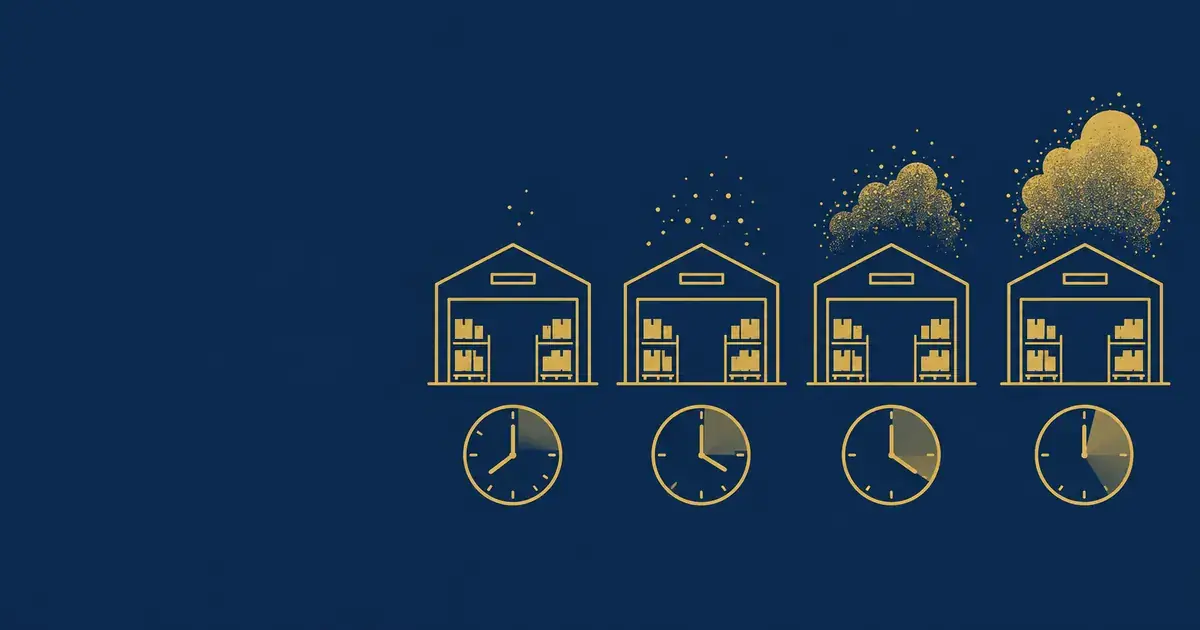
Four areas to schedule
- FLRFloors
- AMNAmenities
- DCKDocks
- HGHHigh-level
How often should a warehouse be cleaned, by type of site?
It depends mostly on how hard the building works. A quiet storage unit may need a floor clean once a fortnight; a distribution centre running three shifts needs its main aisles done every night. The table gives starting frequencies we use on Melbourne sites, as guidance rather than rules.
There is no legal cleaning frequency for warehouses in Victoria. What the law asks is a safe workplace and clean amenities, so the right schedule is the one that keeps your site in that state between visits. Start from the row closest to yours and adjust with the factors further down.
| Site type | Floors | Amenities | Docks | High-level |
|---|---|---|---|---|
| Small storage unit, light use | Fortnightly | Weekly | Monthly | Every two years |
| General warehouse, one shift | Weekly | Weekly | Fortnightly | Yearly |
| DC or 3PL, two or three shifts | Daily on main aisles | Daily | Weekly | Yearly |
| Factory or workshop | Daily in production | Daily | Weekly | Twice a year |
| Packaged food storage | Twice weekly | Daily | Weekly | Twice a year |
| Cold store | Weekly, dry methods | Daily | Twice weekly | Yearly |
Food businesses must also meet the national food safety standards, and FSANZ's guidance on cleaning and sanitising is the place to check what applies to your storage and handling. Treat the food rows above as a floor, not a ceiling. For what each visit should include, pair this table with our task-by-task warehouse cleaning checklist.
What frequency suits your own warehouse?
Pick your site type and answer four questions. The finder starts from the table above and moves each frequency up or down where your answers call for it, giving you a sensible starting schedule to test for a month.
It runs in your browser, and nothing you choose is saved or sent anywhere. The result is a starting point to talk through at a walk-through, not a quote.
Staff should still do a short housekeeping sweep at the end of every shift.
How the finder adjusts the table
- Heavy traffic moves floors and docks up one step
- Heavy dust moves floors and high-level work up one step
- More than 30 people moves amenities up, and more than 100 again
- Doors open all day moves docks up one step
- Light traffic on a small or general site eases floors back one step
What makes a warehouse need cleaning more often?
Five things, in roughly this order: traffic, dust, the goods you store, how many people use the amenities, and how long the dock doors stay open. Any one of them can halve the time a floor stays clean.
These are the same questions the finder asks, and the same ones we ask on a walk-through. They explain why two buildings of the same size can need very different schedules.
Picks, pallets and people
Every forklift pass and pallet jack grinds grit into the floor. A site doing thousands of picks a day wears its aisles far faster than one moving a few pallets a week.
Product, packaging and wind
Cardboard, shrink wrap, powders and building materials all shed dust. So do estates next to construction or bare land, which is common in Melbourne's growing west and north.
What is on the racks
Food, pharmaceuticals and anything for a customer with strict audit rules push frequencies up and add written procedures and records to each visit.
People using the amenities
Toilets and lunchrooms need cleaning in step with the number of people using them. Past a few dozen per shift, daily is the minimum.
Time the docks stand open
Open dock doors let in dust, leaves, rain and birds. Sites with doors up all day need the dock zones on a much tighter cycle than the main floor.
Height and density
Tall, dense racking collects dust up high and makes floors harder to reach, so high-level cleans and under-racking work come round sooner.
What happens if cleaning is left too long?
It gets harder and dearer to fix. Grime that a weekly scrub lifts in an hour can take a full day once it has set, and in the meantime you carry the risk of slips, failed audits, damaged stock and a floor that wears out early.
Cutting frequency is one of the first things to go when budgets tighten, and it can look like a saving for a few months. The costs usually turn up later, and in other parts of the business.
Findings and lost trust
Dust on stock, dirty amenities and blocked walkways are easy things for an auditor to write up. For a 3PL, a poor client audit can put a contract at risk.
Dust on goods
Dust falling from racking tops settles on cartons and shrink wrap. Customers notice, returns go up, and food or pharma goods can end up written off.
Wear you cannot undo
Grit under forklift wheels acts like sandpaper on concrete and sealed floors. Left long enough, it wears the surface and line marking, and that means resurfacing rather than cleaning.
If a floor has already reached that point, the fix is one heavy restorative clean followed by a tighter schedule. Our page on machine floor scrubbing for warehouses explains what that first clean involves, and our high-level and deep cleaning service covers the racking and roof dust that is usually behind the problem.
How do frequencies turn into a cleaning program?
By writing them down. A program lists each task, how often it happens and who does it, then gets checked every month against how the site actually looks. That is how a good schedule survives staff changes and busy seasons.
Most sites also need the schedule to flex. Peak season, a new client or a racking change can push frequencies up for a few weeks; a quiet winter may let them ease back. A written program makes those changes deliberate rather than accidental.
When we set up a program, the first month is a test. We start from the frequencies in this guide, check the site at each visit, and move tasks up or down based on what we find. By the end of the month the schedule fits the building rather than the other way round. After that, frequencies are reviewed every quarter, or straight away if something changes, such as a new client moving in, a second shift starting or construction beginning on the block next door.
Read how our scheduled cleaning programs for industrial sites are built, or book a walk-through and we will draft one for your warehouse.
- Written task list with a frequency for each line
- Monthly check against the real condition of the site
- Seasonal changes agreed in advance
What else do people ask about cleaning frequency?
These three come up on nearly every walk-through.
If yours is not here, bring it to the site visit.